
EvercodeTM TCR products will result in two sets of sequencing libraries: one that corresponds to molecules containing the single cell whole transcriptome (gene expression) and one that corresponds to molecules containing single cell TCR information, such as CDR3 sequences of alpha and beta chains.
TCR Sequencing Libraries
For Evercode TCR v3 or Evercode TCR v4 libraries, we recommend sequencing at 2,000-5,000 reads per cell. Parse TCR libraries require a 300 cycle kit (which will get you up to 318 total cycles as Illumina includes extra reagents as a standard practice). TCR sequencing libraries should be diluted and denatured according to the instruction for the relevant sequencing instrument. We recommended adding 5% PhiX for optimal sequencing quality. TCR libraries contain 5’ Nextera and 3’ Truseq adapters, and the UDI Plate - EC adds Nextera read 1 and Truseq read 2.
The run configuration requirements for TCR sequencing libraries are as follows and paired end sequencing should be used:
- Read: Read 1; Cycles: 242
- Read: i7 Index (Index 1); Cycles: 8
- Read: i5 Index (Index 2); Cycles: 8
- Read: Read 2; Cycles: 58
Note: This run configuration includes a longer Read 1 and is therefore different from whole transcriptome libraries.
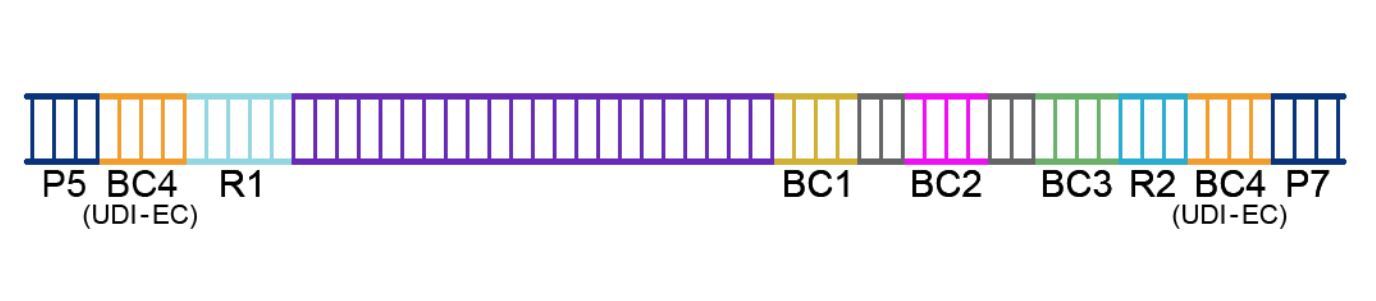
TCR Sequencing Amplicon
The CDR3 is depicted in purple (between R1 and BC1). A final PCR amplifies the TCR Amplification 1 product and appends the fourth DNA barcodes, UDIs from the UDI Plate- EC, as well as the P5 and P7 adaptors.
WT Sequencing Libraries
For WT libraries generated from an Evercode TCR v3 kit, we recommend a minimum sequencing depth of 20,000 reads per cell. Due to improved library efficiency, for WT libraries generated from an Evercode TCR v4 kit, we recommend a minimum of 10,000 reads/cell. However, ideal sequencing depth is dependent on the sample type and experimental goals. A 100 cycle kit minimum is required (which will get you up to 138 total cycles as Illumina includes extra reagents as a standard practice). WT sequencing libraries should be diluted and denatured according to the instruction for the relevant sequencing instrument. We recommended adding 5% PhiX for optimal sequencing quality.
The run configuration requirements for WT sequencing libraries are as follows and paired end sequencing should be used:
- Read: Read 1; Cycles: 64
- Read: i7 Index (Index 1); Cycles: 8
- Read: i5 Index (Index 2); Cycles: 8
- Read: Read 2; Cycles: 58
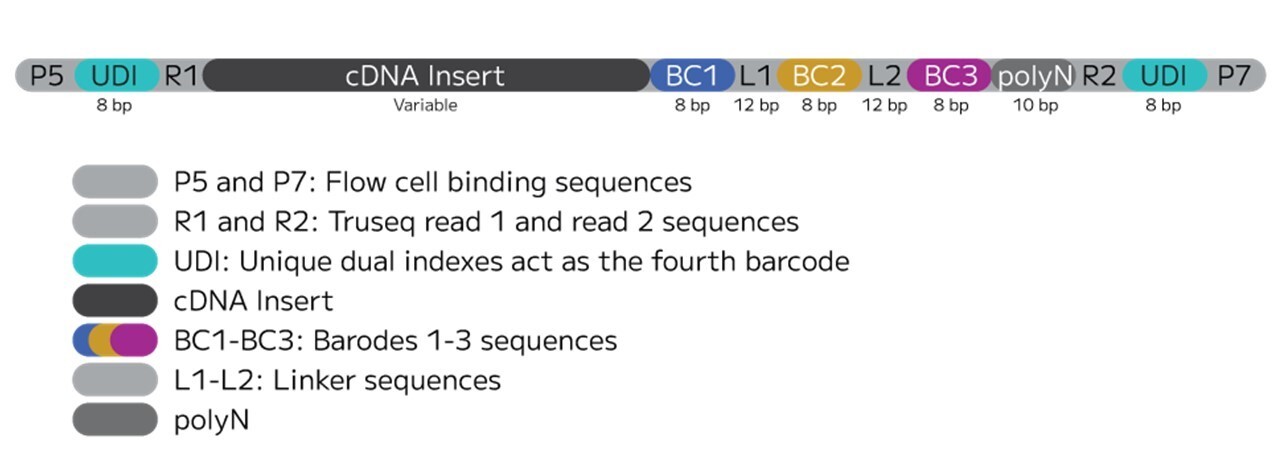
WT Sequencing Amplicon
Details of the final whole transcriptome sequencing library structure are below.
Note: Sequencing both the whole transcriptome libraries and TCR libraries on the same sequencing run is possible, and the TCR run configuration (using a 300 cycle kit) would be required if running all libraries on the same sequencing run. In practice, it may be more cost effective to sequence whole transcriptome libraries separately because you can use an Illumina sequencing kit with fewer cycles, but this may be dependent on your timing, resources, and your pricing for sequencing.
Additional resources
For UDI sequences see: Unique Dual Indices (UDI) Sequences